
Issues
Front Edge of Climate Change
The rich waters of the northern Bering Sea and Bering Strait form the foundation of culture, food security, and economy for Central Yup’ik, Cup’ik, St. Lawrence Island Yupik, and Inupiaq peoples. Indigenous peoples have relied on the abundant marine resources of this region for thousands of years.
The northern Bering Sea and Bering Strait region is vulnerable to ecological transformation and uncertainty due to warming ocean conditions. Satellite and local observations show that the timing, duration, and extent of seasonal sea ice are changing, generating a suite of ecological shifts:
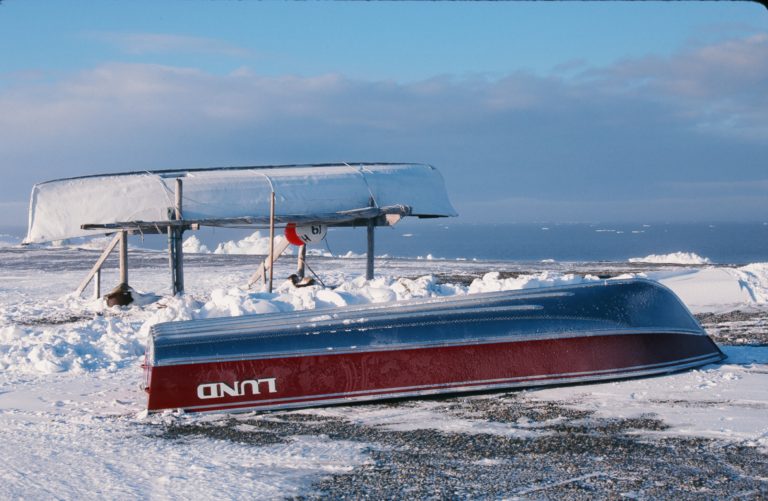
Gambell on St. Lawrence Island. Photo: Jon Nickles
- Biological communities on the seafloor have declined over the past few decades, changing the location and abundance of prey for marine mammals and birds.
- During a series of especially warm years, a wide range of fish species moved north.
- Late ice formation exposes villages to storm surges, resulting in dangerous coastal erosion that may force relocation.
- In some recent years, the retreating ice has drifted north so fast that walrus hunters have been completely unsuccessful.
- Local hunters report that sea ice has been thinner, making traveling on the ice more dangerous.
What the future holds is an open question. Climate scientists forecast that winter sea ice will continue to form in the northern Bering Sea for the time being, but timing, duration and extent of the ice will be less predictable. A warming climate trajectory presents an uncertain future for the ecosystem and our villages will need to adapt to new challenges
CONTACT US
Site by Spiderweb Computers